In exhibits that include more than one of any given species, it can often be difficult to tell one animal from another. Ever wondered how keepers distinguish one from another?
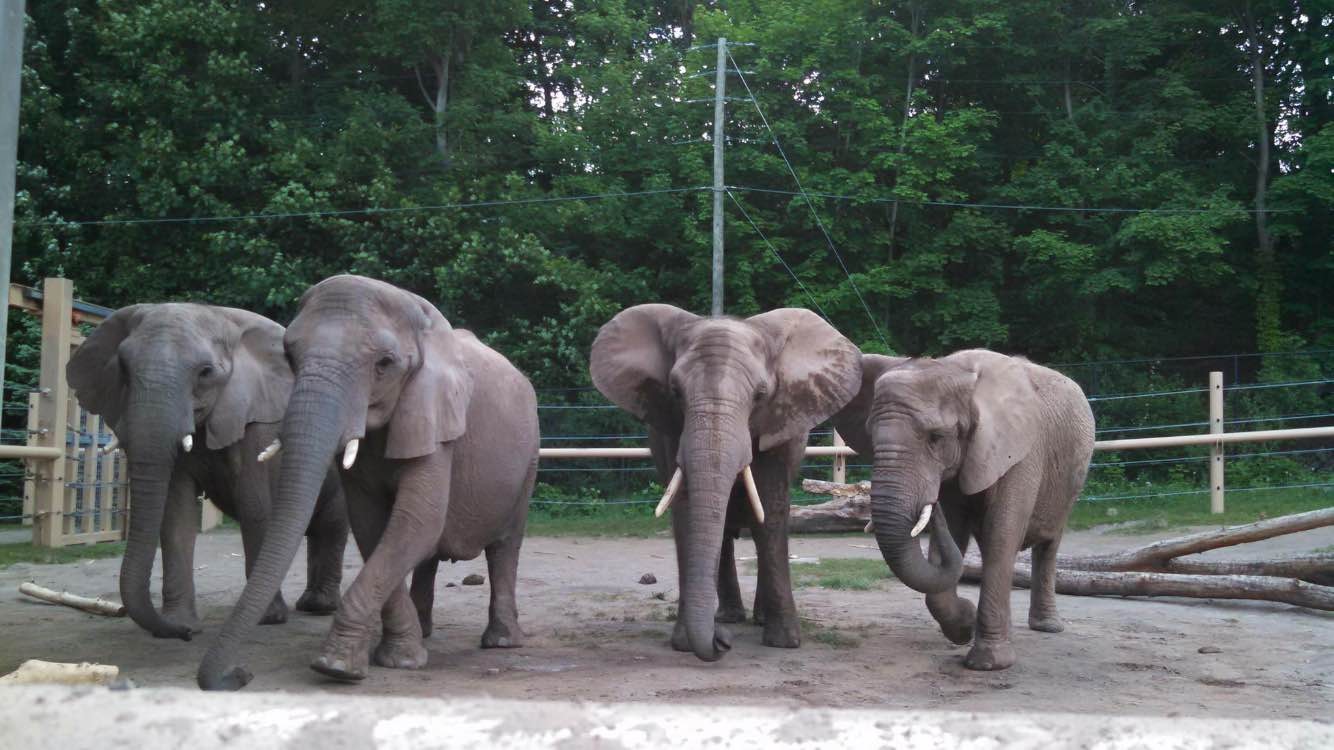
One way keepers and Zoo visitors can distinguish between members of a species is the size of an individual. One good example of this is the elephants. Lilac is the smallest elephant, weighing a little under 8,000 pounds, while Chana and and Genny C weigh almost 9,000 pounds each! The elephants can also be identified by the size and shape of their tusks. Genny C has very long tusks, while Moki has short and stubby tusks.
Note all of the differences between the elephants. Photo by Lindsay Brinda
When looking at birds, we can sometimes tell them apart by their bills. Examples of this can been see in both the Scarlet Ibis and the Sandhill Cranes. One bird has a significantly longer bill than the other. If they are roughly the same size, the length of the bill can be a great way to tell them apart!
Notice the differences in bill lengths between each bird. Photos by Dan Frick
The color patterns on some animals can also help to identify an individual. Some of the frogs here at Seneca Park Zoo are very close in size, but their color or spot patterns can help us to identify them. Sometimes a zoo keeper will use pictures or diagrams of each frog to help identify them while weighing or examining an individual.
Can you see the different spot patterns on each frog? Photos by Dan Frick
Other ways to identify individuals can be the overall color of an animal. Even though they are the same species, often times their coloring is darker or lighter!
Some sturgeon are a brown color, while some are lighter and more grey colored. Photo by Dan Frick
Sometimes individuals can have very small differences that can help keepers and visitors identify them. With twelve baboons at the Zoo, some traits that are used include their size (height/weight), the color of their coat, coloration of their eyes or skin on their face, the length of their tail, or distinguishing traits like their teeth showing or a tongue sticking out!
Can you spot any differences between Pico de Limon and Samson? Photos by Dan Frick
All of these traits can help keepers and visitors distinguish between individuals of a species. This is important because zoo keepers need to be able to identify the animals they work with to make sure they are staying healthy. Being able to identify them, means we can make sure all animals are eating, drinking and acting normally.
Next time you are at the Zoo, see if you can find differences between animals of the same species!
When you walk through the Zoo, you might see a number of unexpected objects in the exhibits: cardboard boxes, paper lunch bags or even a plastic slide. These items are used for enrichment. As keepers, it’s our job to make sure the animals we care for stay healthy, both physically and mentally. By providing the animals with enrichment items, we can encourage them to behave as they would in the wild.
For example, by giving the tigers boxes with food inside, we hope to evoke the natural behaviors involved with hunting. They must find the boxes using their sense of smell, and then they have to work to get the food, using their claws and teeth the same way they would in nature. This helps keep their minds sharp and active.
Seeing an animal interact with their enrichment can be very exciting for our visitors! With our larger animals, their enrichment items are often very clear to see; it’s hard to miss the barrels hanging in the elephant barn or the termite mound in the orangutan exhibit.
But what do we do for smaller animals?
If you have been to the Zoo during the summer months, you may have had a chance to meet some of our education animals. These are animals that aren’t on exhibit, but rather come out for special programs where people are able to meet them up close. These are the same animals that are featured in our other education programs, such as ZooMobiles, ZooClasses and birthday parties. When they aren’t out on programs, it is my job to make sure they are receiving the same care as our other animals, and this includes providing them with (size appropriate) enrichment.
My favorite part of the day is coming up with new and exciting ways to exercise our education animals’ minds. When coming up with enrichment, I want to think about what the animal would do in the wild and try to bring that behavior out.
For example, our armadillo Doug loves to dig for insects. I sometimes will give him a huge pile of wood chips, pine shavings, and cat litter with mealworms tucked inside. To get the worms, he has to dig though the pile, which he does with enthusiasm.
Our hedgehogs and short-tailed opossum also love to forage for insects. By hanging paper towel tubes in their enclosures with meal worms inside, we encourage interaction with their surroundings.
While food is always a good motivator for an animal to get active, it’s not the only way to enrich an animal. Sometimes a bag filled with paper is enough, or a box sprayed with perfume. The unfamiliar scent is interesting and therefore will encourage exploration. Plus, boxes and paper bags make great new hiding places. Changing the arrangement of their enclosure or adding new furniture can be a great form of enrichment as well.
There is never a slow day working at the Zoo, and making sure the animals have the opportunity to use their minds is one of our many responsibilities (it’s also one of the best). It’s a chance for the animals to express themselves and a chance for us to really get to know each animal’s personality on an individual level.
Big or small, enrichment is a vital part of the day for every animal at the Z
oo.
Last week, the Democrat and Chroniclefeatured the Zoo in their latest “Hot Jobs” column. General Curator David Hamilton answered questions about his busy days, his favorite animals and how Zoos fulfill conservation goals around the world.
Photo by Mike Bradley
Polar bears seem to get all the attention in climate change debates, but David Hamilton wishes snow leopards, frogs, sturgeon and other animals threatened with extinction shared the limelight.
“People don’t always realize how intricate and involved the lives of animals are,” said Hamilton, general curator of the Seneca Park Zoo, which has about 180 species, “and how the whole world is tied together.”
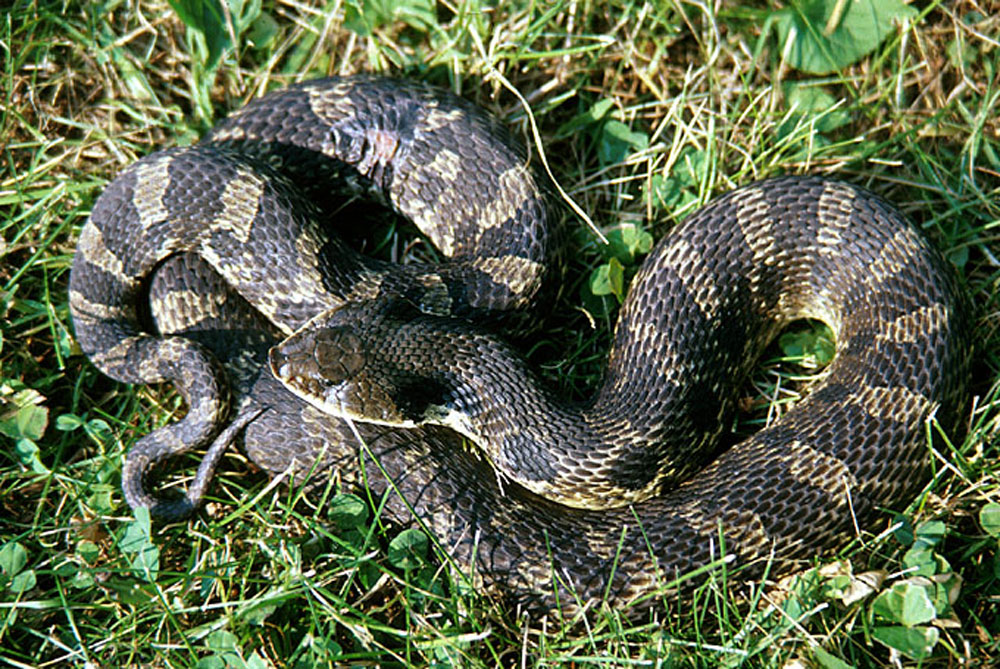
Our eastern hog-nose snake animal sign next to its exhibit at the Zoo will tell you the snakes’ natural range, diet, threat level and some other interesting facts. What no sign can convey is how theatrical these snakes really are: if there was an Academy Award for the most dramatic snake, the hog-nose snake would go home with the Oscar.
Photo by Jeff LeClere
If a hog-nose snake is threatened, it has quite the repertoire of movements and behaviors to distract and evade an attacker. The first tactic the hog-nose snake will use is to flatten out its head, giving it the appearance of having a hood, like a cobra. It then will take a very deep breath to inflate itself and then release the breath causing a loud hissing sound. If this had not deterred its irritant, the hog-nosed snake will strike. The snake does not open its mouth to bite, it only strikes at the attacker by hitting the attacker with its nose and face. A lot of other snakes will use these same types of scare tactics to ward off an attacker; however, other snakes will typically bite when they strike. The rest of the hog-nose snake’s dramatic tactics are specific to this species.
Photo by Amanda Davis
When hooding up, hissing and mock-biting will not deter a threat, the hog-nose snake will flail around, appearing to be having convulsions. The convulsive fit includes the snake thrashing around with its mouth open with its tongue hanging out. This performance is ended by the hog-nosed snake rolling onto its back and playing dead with its mouth open and tongue hanging out. The snake will even go as far to appear to have blood coming from its mouth and anus, as well as defecating and excreting a foul odor. When the snake is picked up, it will be limp. If the snake is set back down with its belly down, it will quickly flip over so it is upside down on its back again. After some time has passed, the snake will pick its head up and check for danger. If the threat is gone, it will roll over and scurry away.
The eastern hog-nose snake gives the best performance when evading an intruder. There are other snakes out there that have their own tactics when being confronted by a threat, but none give the convincing dramatic performance like that of the eastern hog-nosed snake. The eastern hog-nose snake in the ECO center at the Zoo typically will not put on this dramatic performance because they have a pretty easygoing life and don’t have the need to act out. They are capable of it, however, and would give the performance of a lifetime if needed.
Learn more about eastern hog-nose snakes and other species of reptiles and amphibians at Snakes and Friends Day this Saturday, August 22!
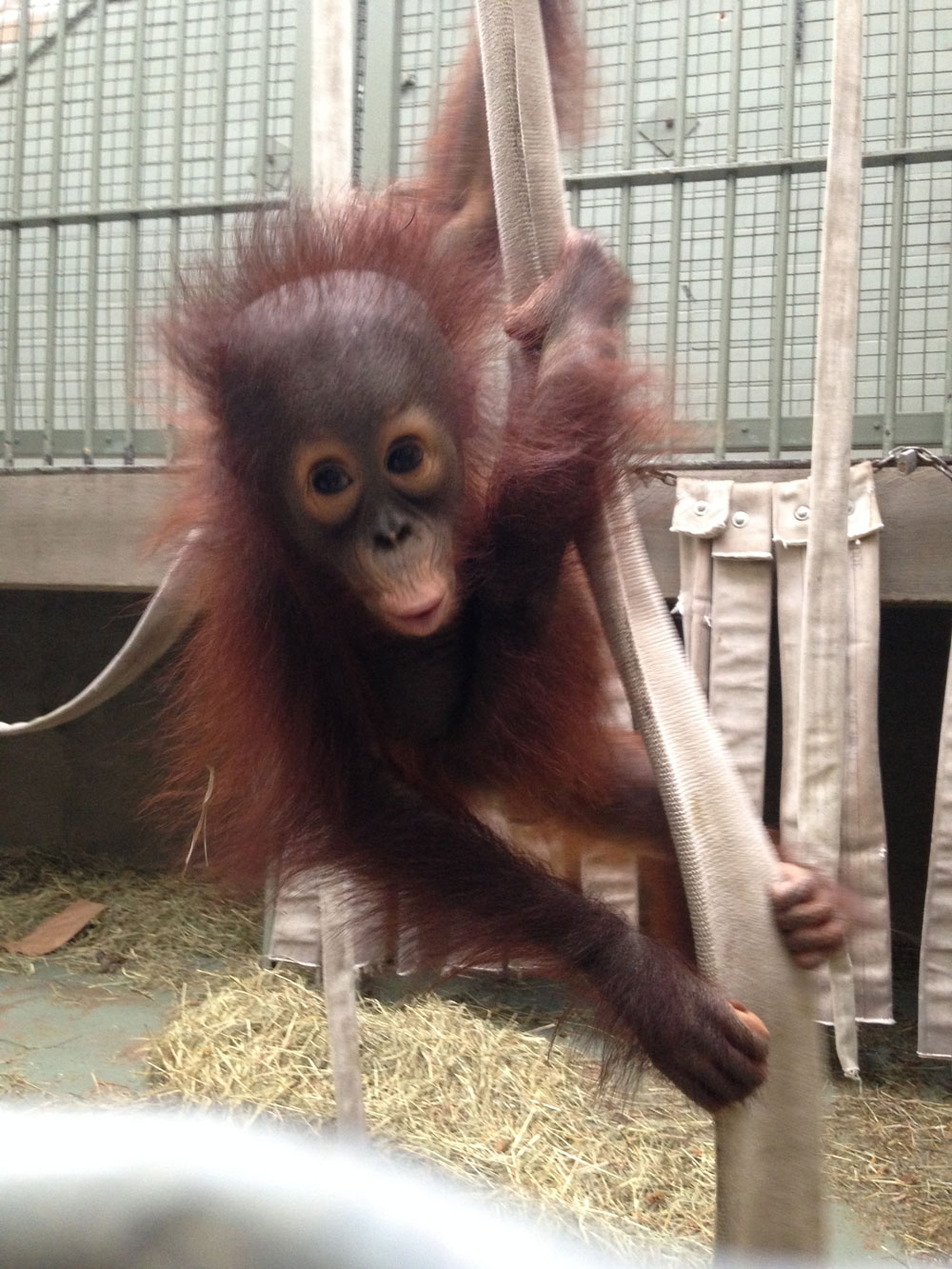
Bornean orangutan Bella and her parents Kumang and Denda have just been enrolled in an enriching research program where their decision-making and mathematical skills will be scientifically assessed on exhibit for Zoo guests to observe.
Bella, photo by Mike Wemett.
The University of Rochester Cognitive Sciences research lab of Dr Jessica Cantlon will be expanding its ongoing research with our olive baboon troop to include 36-year-old Kumang, 12-year-old Denda and 2-year-old Bella. Earlier this week, Denda demonstrated impressive finger and tongue dexterity skills in his first trial, starting with games and treats. The tasks will become more engaging and technical over time, advancing to double sided touch screens where Zoo guests will be able to watch the orangutans demonstrate cognitive skills.
Denda and Sara, one of Dr. Cantlon’s research assistants. Photo by Dr. Jeff Wyatt.
“Bella is curious and playful,” says zoo keeper Mike Wemett. “As a zoo keeper, I have the privilege of watching her grow up and learn from her mother, and this research will track some of that development.”
Bella, photo by Mike Wemett.
Engaging science to better understand orangutan intelligence will help us advance novel approaches to designing new programs and exhibits that are stimulating and enriching.
—Dr. Jeff Wyatt, Director of Animal Health and Conservation
Frogs and toads have a lot in common. They are both amphibians in the order Anura, which means “without a tail.” Toads are a sub-classification of frogs, meaning that all toads are frogs, but not all frogs are toads. They both reproduce in water, and they even look alike.
Lemur leaf frog and Panamanian golden frog (actually a toad). Photo by Kellee WolowitzLemur leaf frogs. Photo by Kellee Wolowitz
It can be pretty easy to get them mixed up, so here are some hints to help you tell frogs (family Ranidae) and toads (family Bufonidae) apart.
Both frogs and toads live near ponds, swamps, and marshes. Frogs can live on the ground or in trees. But toads live only on the ground.
Both frogs and toads have stubby front legs, but frogs have slimmer bodies and longer hind legs. These limbs are especially good for leaping from tree to tree and for swimming.
Green and black poison dart frog. Photo by Kellee Wolowitz
Frogs usually have webbed hind feet, and some have webbed front feet. Toads have shorter hind legs, good for hopping around on the ground or walking and crawling. They are a bit slower and less active than frogs. Most toads don’t have webbed feet or sticky toe pads. They move by a series of short hops on land.
Green and black dart frog. Photo by Kellee Wolowitz
Frog skin is usually smooth and moist. Toad skin is drier and bumpier. The bumps look like warts and feel rough to the touch.
Yellow banded dart frogs. Phone by Kellee WolowitzAfrican bullfrog. Photo by Kellee Wolowitz
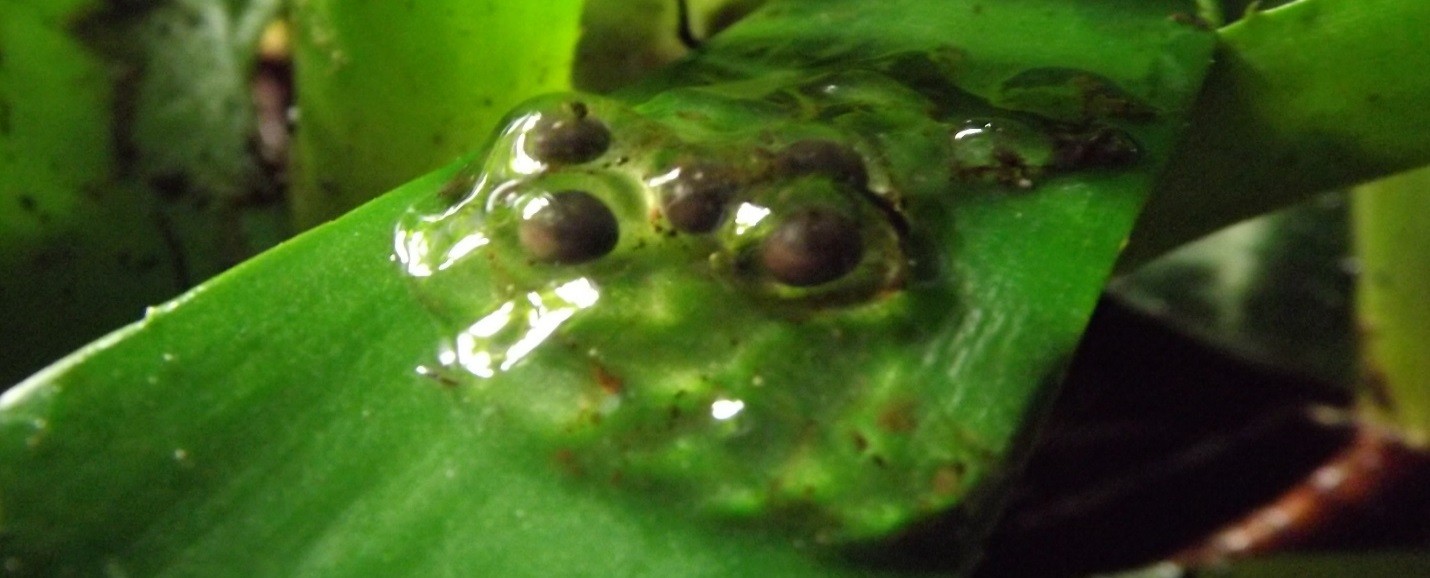
Frogs lay eggs in bunches, or clusters, which have a jelly-like substance around them. Toads lay their eggs in lines or strands on the leaves of plants that live in the water.
Green and black dart frog eggs on a leaf. Photo by Kellee WolowitzGreen and black dart frog tadpoles developing inside eggs. Photo by Kellee WolowitzPanamanian golden frog (actually a toad) with eggs. Photo by John AdamskiPanamanian golden frog tadpoles. Photo by Kellee Wolowitz
These are the basic differences between frogs and toads, but things can still get confusing! The Zoo houses Panamanian golden frogs in the Main Building, and although they have frog in their name, they are actually toads!
However, for the most part, these guidelines will help you distinguish between the two types of amphibians.
Panamanian golden frog (actually a toad). Photo by Kellee Wolowitz
Seneca Park Zoo has been home to many animals for nearly 120 years, each one unique and special in its own way. Keepers are often asked if they have a favorite, whether it’s an entire species or an individual animal, and for me the answer is always the same: there have been too many wonderful creatures of all kinds that I’ve had the privilege to spend time with for me to have a favorite.
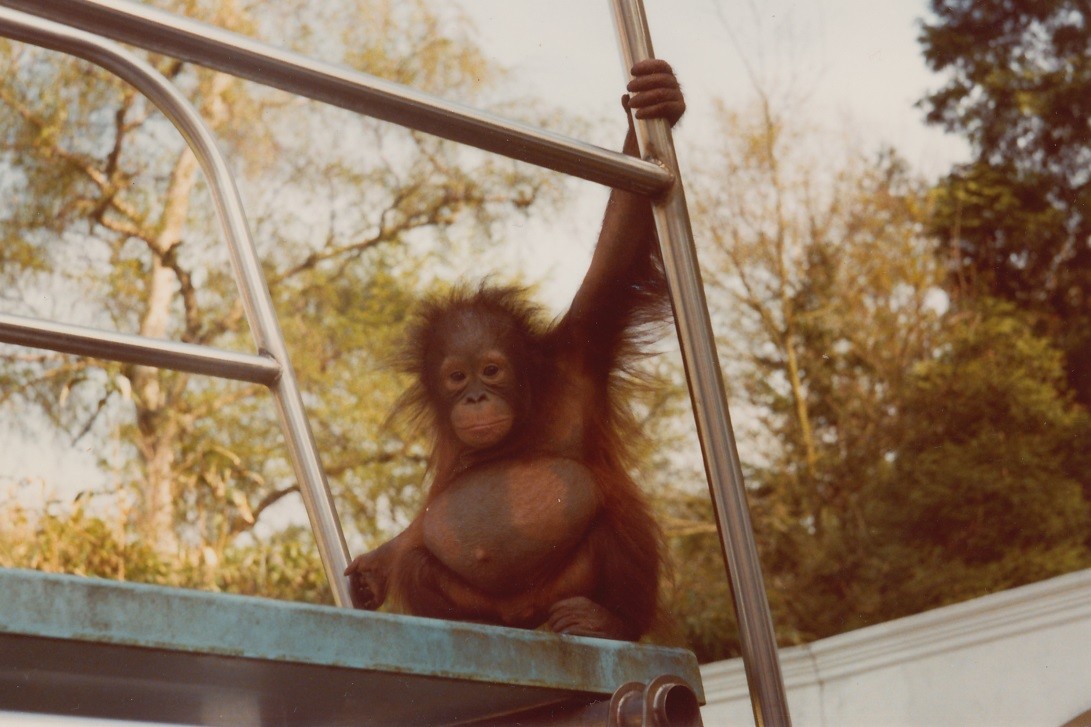
There is one species, however, that seems to bring out the best in me as a keeper and a person, and that’s the orangutans. One of them in particular, our matriarch Kumang, has done more to open my mind and heart than any other animal.
Kumang’s story starts long before her arrival here at Seneca Park Zoo back in 1991. She was born October 15th, 1977 at Belle Vue Zoological Gardens in Manchester, England. Her parents were Harold and Bobo, both caught in their natural range in 1959 (a common practice back then) at the approximate age of 4 years old. At the time of Kumang’s birth, Belle Vue was in the process of closing for good, and one month later all the zoo’s orangutans as well as a few other animals were sold to Weybridge, a private zoo in the suburbs of London.
Baby Kumang, photo courtesy of Jeremy Keeling
Weybridge was owned by Gordon Mills, the manager of several popular singers including Tom Jones and Gilbert O’Sullivan. One of the keepers at Weybridge was Jeremy Keeling, who later co-founded a highly successful primate rescue center called Monkey World. Jeremy (who actually named Kumang) also wrote a book about another orangutan named Amy, and in it he touches on Kumang’s early years.
Sadly, Kumang’s mom died when Kumang was only 18 months old and it was up to Jeremy to step in as surrogate mom. He writes about how at first, Kumang wanted nothing to do with him and resisted bottle feedings, even though she needed them to survive. Eventually he won her trust as he would take her to visit other orangutans during the day, and then she’d curl up beside him at night. If it wasn’t for Jeremy’s compassion and determination, Kumang and her extended family would not be here today.
Photo courtesy of Jeremy Keeling
What makes this episode in her life noteworthy is that despite losing her mom while still a baby and being partially hand-reared (an experience that tends to have a negative impact later in life) especially for primates, Kumang has always been an exceptional mother to all four of her offspring.
In 1984, Gordon decided to close his zoo and donated all of the orangutans in his collection to the San Diego Zoo. This stared a new chapter in Kumang’s life, the highlight of which was her proficiency at escaping the confines of her exhibit at least half a dozen times. Stories have circulated online about Kumang’s adventures as she and her friends completely foiled all attempts by the staff to contain them. You have to admire such determination and creativity!
Photo courtesy of Jeremy Keeling
In 1991, the Orangutan Species Survival Plan made a breeding recommendation for Kumang to be loaned to Seneca Park Zoo along with Jiggs, a wild-caught adult male with a successful breeding record from Hogle Zoo in Utah. Jiggs arrived here first, and Kumang one month later. Introductions went well and soon they were enjoying each other’s company. Kumang became pregnant shortly afterwards, and I remember how anxious the staff felt about whether or not she’d know what to do, being a first time mother. We didn’t know her history, if she’d ever seen or been around babies, or been mother-raised herself.
In 1992 their first baby was born, and any doubts about Kumang’s parenting skills were quickly erased. She was an absolute perfect mother in every way, and Jiggs as an already experienced father knew to keep a respectful distance while mother and son bonded. We named the young orangutan Bandar, after a village in his native Borneo. As Bandar got older and wanted to play or just get some attention, Jiggs was happy to oblige. It was very touching to watch Kumang care so lovingly for Bandar, and to watch the 300-plus-pound Jiggs play so gently with him.
Photo courtesy of Jeremy Keeling
Bandar now resides at the Henry Doorly Zoo in Omaha and has been a good father to 4 offspring of his own.
Bandar in 2014, photo courtesy of Jeremy Keeling
Kumang went on to have another offspring with Jiggs, a female named Dara. In January 2001, Jiggs passed away at the approximate age of 35 years old. It was a sad day in Seneca Park Zoo history, as Jiggs was an exceptional animal and well-loved by those that knew him.
Later that year, the Species Survival Plan recommended that Lowell, from the San Diego Zoo, be sent here to be Kumang’s new mate. Together they had a son named Datu, who now resides at the Henry Vilas Zoo in Madison, Wisconsin. As of this writing, Datu has just become a first-time father to baby Keju, who is doing well at Henry Vilas Zoo.
Datu, photo courtesy of Jeremy Keeling
Lowell passed away from a stroke in 2006. Kumang continued living with her daughter Dara, and in 2011, a young male named Denda from Chicago’s Brookfield Zoo came to live with them as another breeding recommendation for Kumang. Dara was sent to the Virginia Zoo in Norfolk a short time later to hopefully start her own family. Her new home is a spacious habitat with lots of grass, a waterfall and four-story climbing structure. We’re all very happy for her.
Dara at Norfolk Zoo, photo courtesy of Jeremy Keeling
Meanwhile, Denda has been a good partner for Kumang, as he engages her in play on a regular basis (whether she wants to or not). Thanks to him, Kumang’s activity level has gone up, and that’s a good thing. Together Kumang and Denda have a daughter named Bella, born on April 29th of 2013. As usual, Kumang has been a perfect mother to Bella, and Denda has shown great gentleness when he plays with his daughter.
Looking forward, Seneca Park Zoo is about to undergo some exciting changes in the not-so-distant future. A new and spacious habitat for our orangutans is expected to be a part of those changes. The staff is thrilled about the prospect of new quarters for our orange friends and look forward to seeing them happy together for years to come.
Kumang and Bella, photo by Kellee Wolowitz
Seneca Park Zoo would like to offer special thanks to Mr. Jeremy Keeling for saving Kumang, and for providing photos and insight into her early life. Until this year, we never knew anything about Kumang’s life in England, and from what we’ve learned, we all feel much closer to her now. I will be forever grateful to him for providing us with that information.
Jeremy’s lifelong passion and dedication to saving unwanted and abused primates through Monkey World is an inspiration, to say the least.
I highly recommend Jeremy’s book Jeremy and Amy. It’s an incredible story, made even more so because a small part of it is our very own Kumang’s story.
Join us for Ornagutan M.O.M. Weekend this Mother’s Day weekend and learn about the Missing Orangutan Mothers (M.O.M.) Campaign, which is bringing attention to the crises facing these beautiful animals by encouraging people to help protect them. Join Zoo staff and volunteers as we honor and celebrate our own orangutans, Kumang, Denda and Bella, and wear #OrangeforOrangs to show your support for conservation.
I am often asked this question by visitors while the elephants are enjoying a delicious truckload of browse that the keepers have collected for them. Browse is defined as “shoots, twigs, and leaves of trees and shrubs used by animals for food.”
Seneca Park Zoo implements a browse program as part of the elephant management program. This is a requirement for accreditation by the AZA (Association of Zoos and Aquariums). The elephant staff works very hard to provide Genny C and Lilac with a variety of browse as often as possible.
The goal is to encourage species-appropriate appetite behaviors, as well as to promote dental health. Since elephant teeth migrate forward (not vertically), it is important that the right type of food is offered to promote dental health and allow for the natural progression of each molar.
The elephant staff offers types of browse that have been approved by our veterinarian as safe for the elephants to eat. Staff is trained to be able to identify various species of trees that are native to Western New York. Seneca Park Zoo has relationships with several local towns and tree companies who are happy to help provide the elephants with browse.
So the answer to the question “Do the elephants really eat trees?” is YES! Their favorites are sugar maple, Norway maple, silver maple and willow. They eat the leaves and small branches completely, chew the bark off of the medium size branches, and use their tusks to scrape the bark off of the large logs.
Blog by Sue Rea, Zoologist; Photos by Sue Rea and Jenna Bovee, Elephant Handler
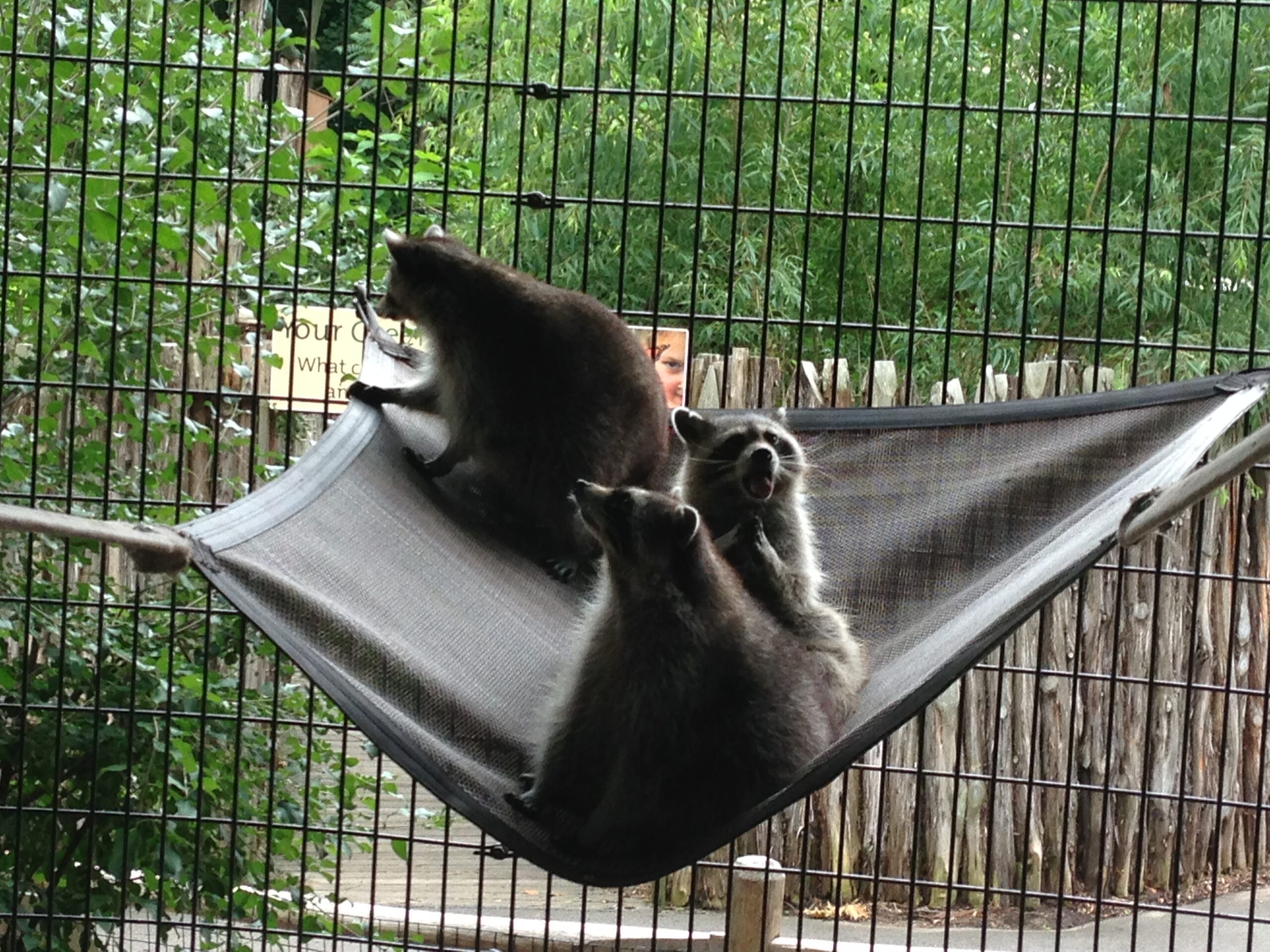
A lot of visitors ask why the Zoo has raccoons on exhibit, saying “If I wanted to see a raccoon, I would just look out in my backyard.” While this may be true, I guarantee you do not have raccoons quite like Willow, Buffy and Xander in your backyard!
Our raccoons came from Disney and were a part of a show there. We had hoped in our summer stage show, however that did not end up happening. Instead, they get to lounge about at their leisure and venture around when they see fit. You may notice they spend more time lounging than running about. We do give them a lot of different enrichment: puzzle feeders, where they have to work for their food.This gives them physical and mental exercise. They are very smart and crafty animals that need to be challenged and stimulated.
Since they are so smart and food motivated, they catch on to training behaviors very quickly. They are trained to shift on and off of exhibit, into and out of their den; have a litter box that they use every day and are target trained to touch their hands and nose to the end of a target pole. The trio is also trained to sit on a scale to be weighed. Buffy is one that sometimes won’t get off the scale because she is looking for more rewards. The newest behavior they are working on is injection training, and they are doing very well with that.
Although they are food motivated, they are extremely picky. They only like apples, pears, grapes, blueberries, and occasionally, pineapple. They turn their noses up at strawberries, peaches, watermelon, plums and other fruits. They will eat cooked sweet potato every once and a while, but refuse other vegetables. They also don’t like honey, and will only eat sweetened cereals. They occasionally eat yogurt, baby food and jello. They do like hard-boiled eggs and the carnivore diet meat and thankfully seem to enjoy their dog food, which is the bulk of their diet.
Buffy, Willow and Xander may look like the average raccoon that you might see in your back yard, but they are far from average. They are very smart, picky, adorable little mischief makers that are hard not to love.
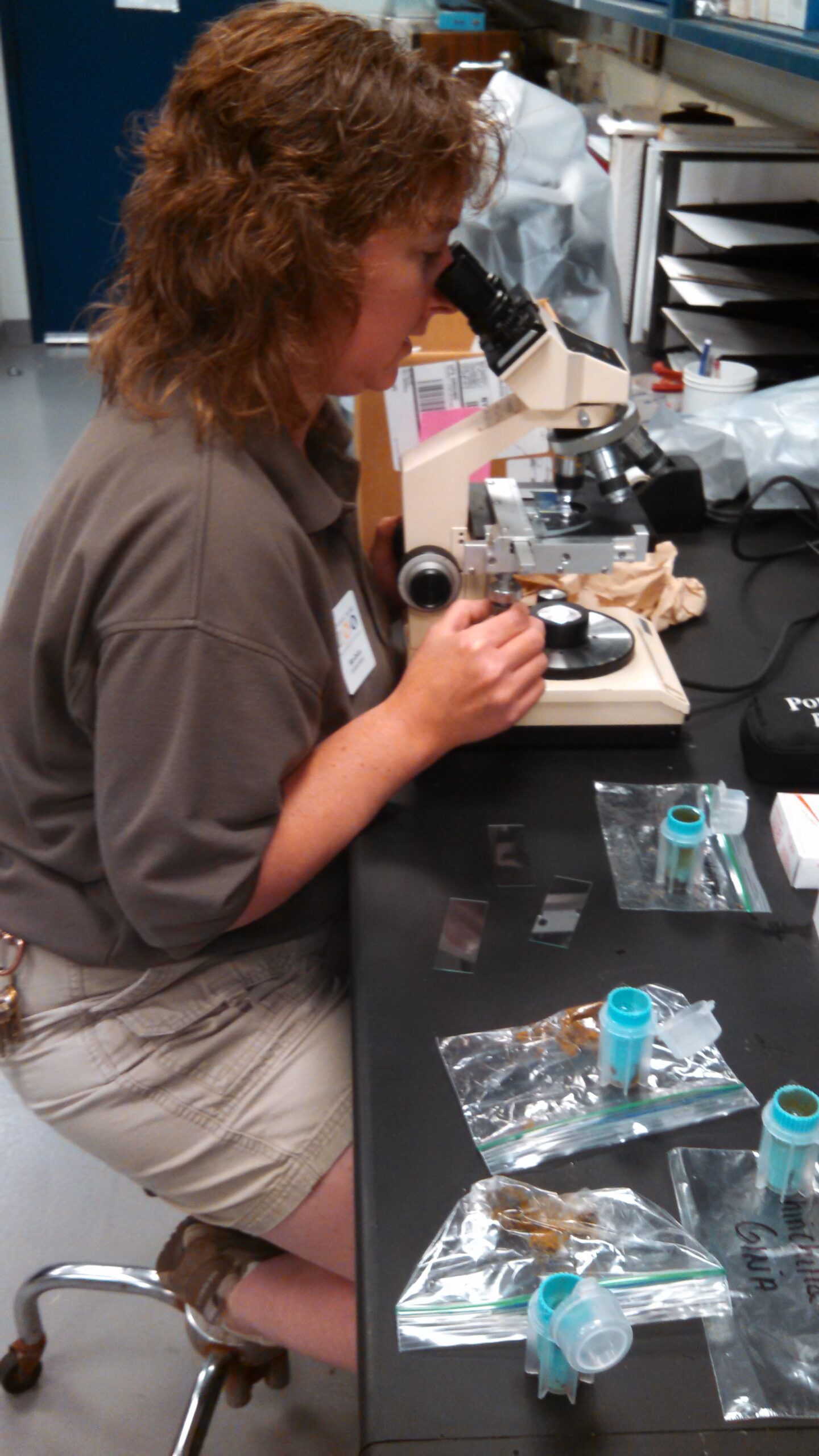
…poop. OK, so it isn’t really a word, but the study of animal droppings is a big part of the Seneca Park Zoo’s animal preventative health program.
Droppings from all the Zoo’s animals are examined annually to help assess the health of the collection. They can reveal a number of things about the animal and requires very little effort on the part of the animal and the staff. When testing animal droppings, there are three main components that are evaluated.
The first is general appearance. Does it look normal? Inconsistencies in appearance can mean a more underlying problem that may require additional tests.
Second: Is there anything there that shouldn’t be there? Foreign objects can sometimes find their way into the digestive tract of animals. Most pass through and are easily identified in droppings. If we know something had been ingested, we can check to make sure it passes through. If not, we can take other measures to help move things along.
Third is a microscopic exam looking for internal parasites. This is the part where we look for worms and other invaders. Parasites can cause additional trouble for our animals and any positive results are evaluated by the veterinarian for the proper course of treatment.



 If you have been to the Zoo during the summer months, you may have had a chance to meet some of our education animals. These are animals that aren’t on exhibit, but rather come out for special programs where people are able to meet them up close. These are the same animals that are featured in our other education programs, such as ZooMobiles, ZooClasses and birthday parties. When they aren’t out on programs, it is my job to make sure they are receiving the same care as our other animals, and this includes providing them with (size appropriate) enrichment.
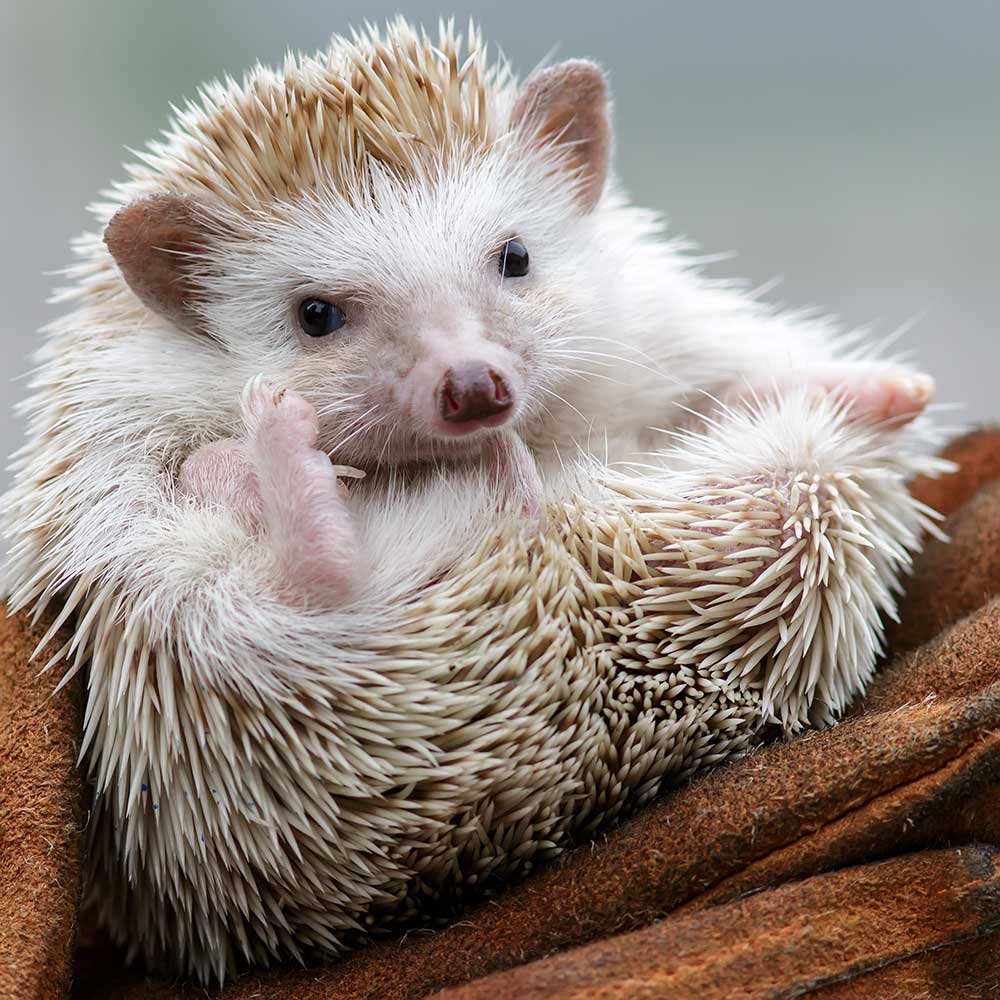
 Our hedgehogs and short-tailed opossum also love to forage for insects. By hanging paper towel tubes in their enclosures with meal worms inside, we encourage interaction with their surroundings.










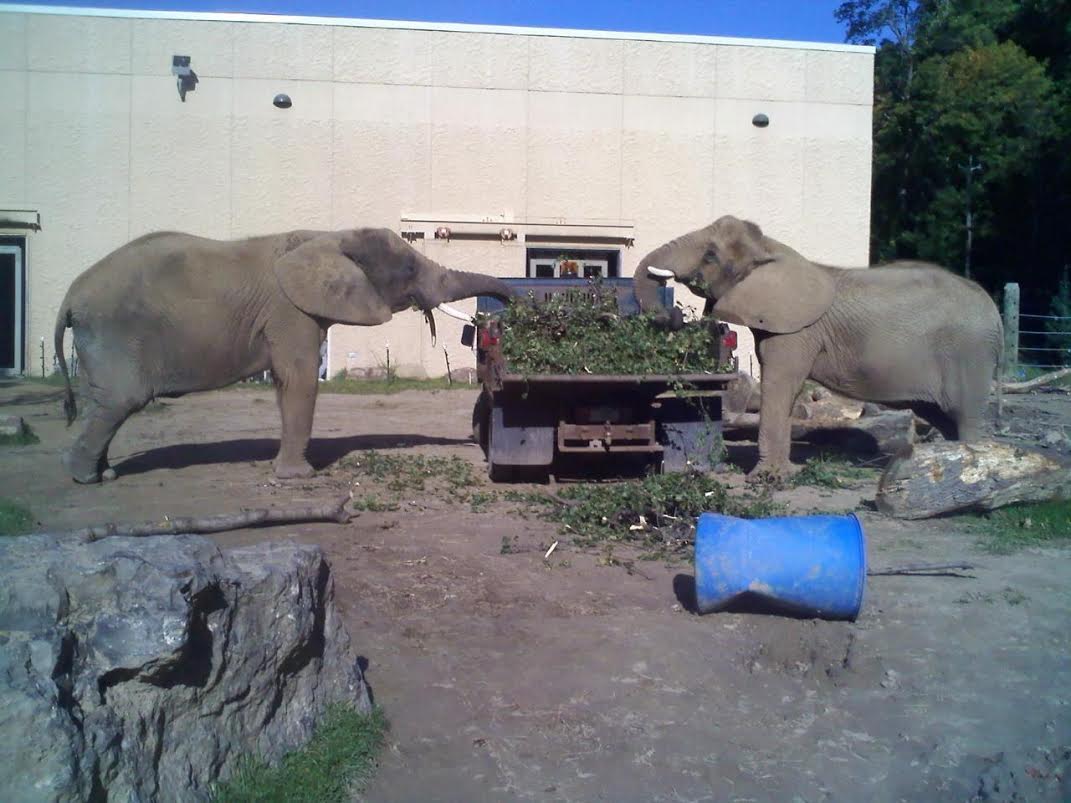

 The goal is to encourage species-appropriate appetite behaviors, as well as to promote dental health. Since elephant teeth migrate forward (not vertically), it is important that the right type of food is offered to promote dental health and allow for the natural progression of each molar.
 So the answer to the question “Do the elephants really eat trees?” is YES! Their favorites are sugar maple, Norway maple, silver maple and willow. They eat the leaves and small branches completely, chew the bark off of the medium size branches, and use their tusks to scrape the bark off of the large logs.