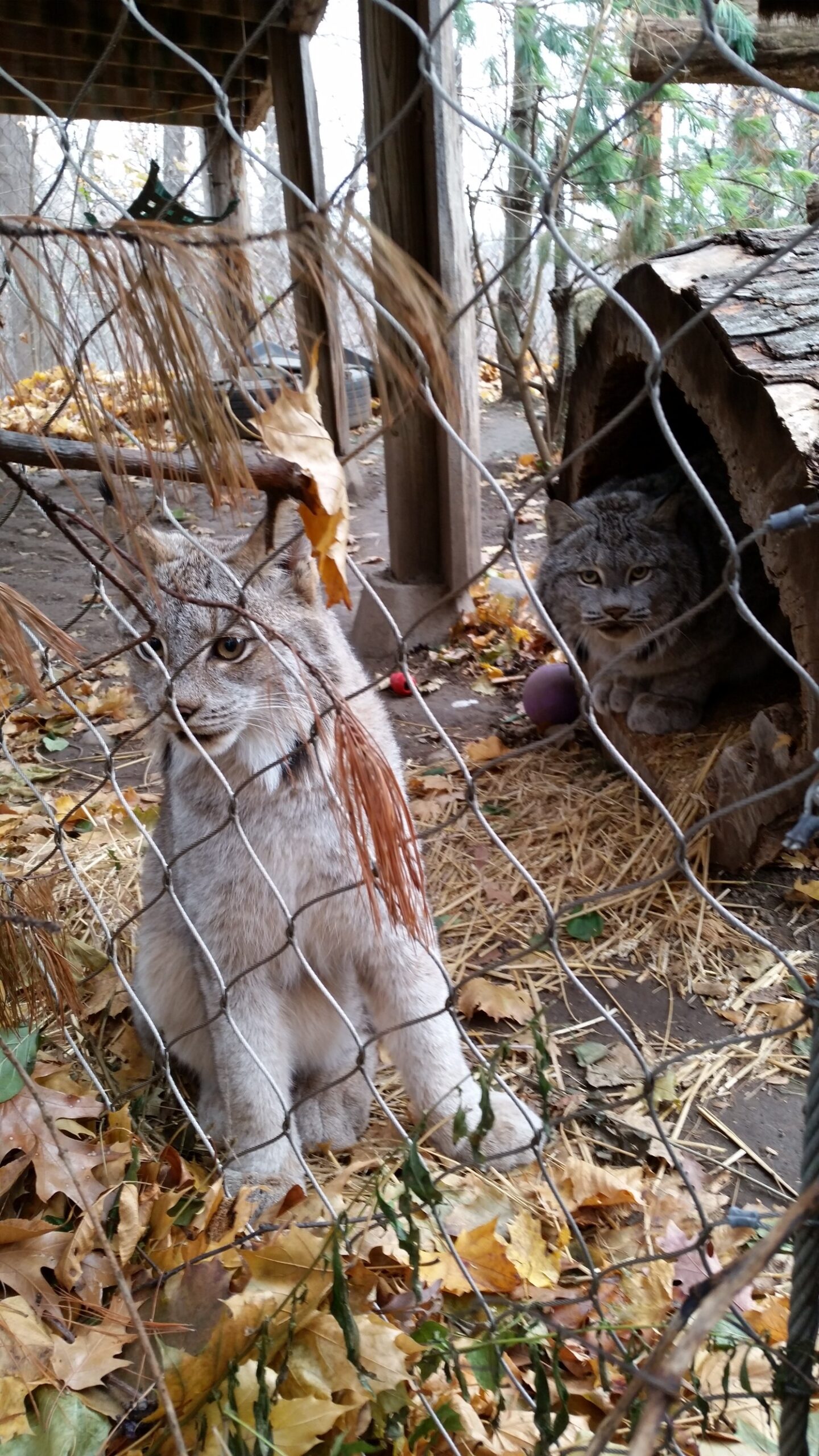
Our Canada lynx pair have been busy adjusting to living with one other during the past few months. Our 2-year-old male, Gretzky, has resided here since April of 2013, while our 1-year-old female, Bianca, joined us in September 2014.
From the very first day she arrived, Bianca has made herself right at home. She was comfortable with her keepers and her surroundings almost immediately. The day we introduced Bianca and Gretzky, she approached him within seconds. From the beginning she vocalized little chirps at him, and hasn’t stopped since. Gretzky, on the other hand, was slightly taken aback by her boisterous greeting, and it took him a while to warm up to her.
They can now be found playfully chasing each other around their exhibit, and they have even been spotted sharing the same log lately. Inside their indoor holding area, they share meals together and spend their nights there, too. Keepers are waiting for the day when we see them actually snuggled up together. Who knows, maybe it will happen this winter during mating season.
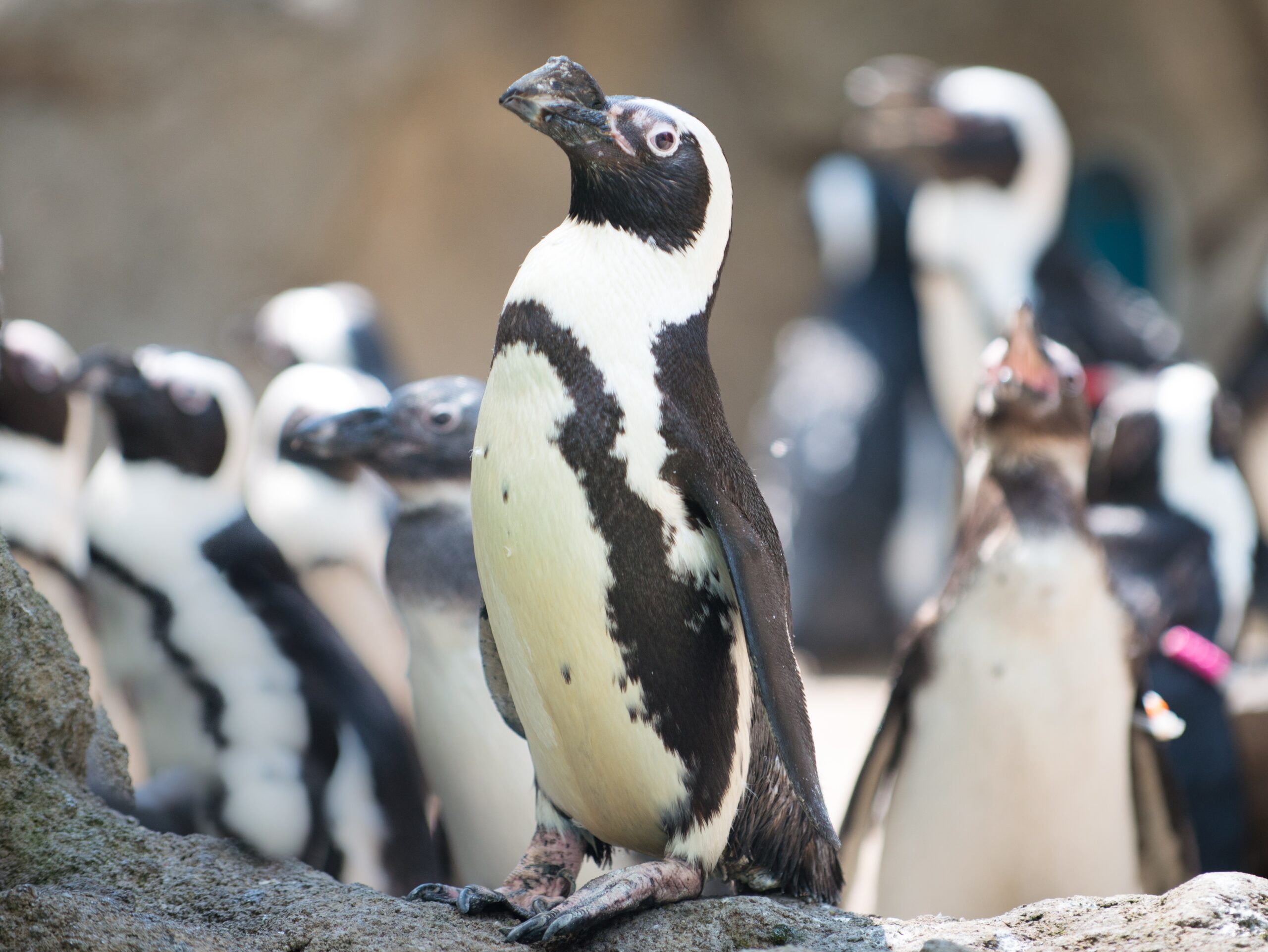
Here at the Zoo we currently have a colony of 36 African penguins: 28 adults, seven juveniles, and one chick. With so many birds running around, two of the most common questions I get as a penguin keeper are: “How do you tell all of them apart?” and “How do you keep track of all those penguins?”
Well, for me, telling them apart is easy. Each penguin has a band with colored beads on either their left or right wing. Each mated pair of penguins and their chicks have the same color or combination of colors, with males banded on the left, and females on the right.
When it comes to keeping track of them, it’s more than just being able to tell them apart. It’s about knowing each individual penguin enough to tell if they’re acting in an irregular way. For example, a typically good eater not eating as much as they normally do, or a social butterfly that seems to be separating themselves from the rest of the colony, indicates that something could be wrong. Then again, they could simply be getting ready to lay an egg.
Animals are not good at letting you know if they aren’t feeling well. So, we need other methods besides behavioral observations to keep track of their health. One way we can tell if something might be wrong is by keeping track of weights. At the beginning of every month, we weigh the entire colony. All of the penguins are used to being weighed, so it’s a fairly easy process. Check out the video below to watch the routine.
Don’t forget to visit the Zoo on Monday, October 13th for Penguin Awareness Day! There will be keeper talks, penguin feeding demonstrations, and we have some great silent auction items to bid on that day, too. Hope to see everyone there.
The ZooTeen program, which began in 1993, gives young adults the opportunity to explore their interests in ecology and conservation. ZooTeens spend the summer at stations throughout the Zoo educating our visitors about Zoo animals and important environmental concepts. Isabella Fazio, a ZooTeen for several years, shares this blog post with us.
Hi! I’m Isabella Fazio, a 2nd year ZooTeen here at the Zoo. Last year, after I participated in the palm oil station, I learned about the biggest problem orangutans were facing in the wild: Deforestation. People cut down trees that orangutans called home in order to get a creamy, high-demand oil called palm oil.
After the trees are gone, palm oil plantations are then built where the beautiful jungles once were. Besides just destroying countless animal homes, the trees also release carbon dioxide into the sky, contributing to global climate change. But it isn’t all bad. At the palm oil station, I learned that more and more companies are beginning to grow their own palm oil on their own land which is called sustainable palm oil.
What we ZooTeens can do to show we care for orangutans and the environment is support companies that use sustainable palm oil. Right now you may be wondering how you can figure out if your favorite food has sustainable palm oil or not. Well, there are a few ways to tell.
Head to the Roundtable of Sustainable Palm Oil’s Web site.
The Cheyenne Mountain Zoo has a palm oil shopping guide on their Web site. Their list has a bunch of sustainable palm oil users and companies that promise to change their ways in a couple of years.
Use the Cheyenne Mountain Zoo’s app, if you have a smart phone. Just search “palm oil” and it will be the first app to come up. Also, it’s free! You can use the app to search for any product you are concerned about and it will tell you if it is orangutan friendly or not.
If these sources happen to tell you that your product is not orangutan friendly you can write or e-mail the company to stop using palm oil.
This DOES work. For a long time big companies like Nestle, Heinz and Nutella were using non-sustainable palm oil. But thanks to concerned people like us, the pressure was too much for the companies and they switched to sustainable palm oil.
Besides checking the label in your own home, SPREAD THE WORD! On August 1, to earn my Girl Scout Silver Award, I did my own project at the Seneca Park Zoo talking about palm oil to guests and passing out palm oil shopping guides. By the end of my project, I had talked to more than forty-six guests that day! Even if my message gets to one person, that one person could help make a difference for orangutans.
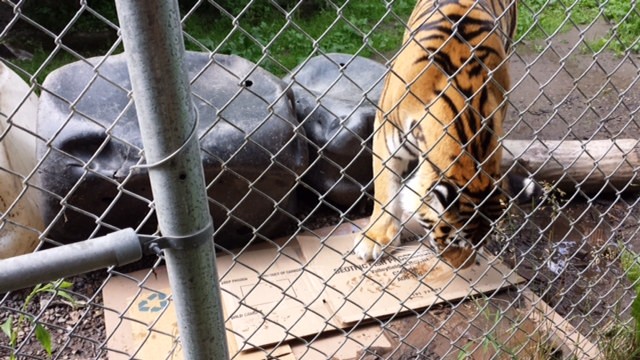
Sometimes it’s as easy as placing some of them on a scale and getting a reading. Others, like our Amur tigers, may need a little convincing.
The staff works hard and can be very patient and inventive. Using barrels or other large objects to create a walkway, a large board is placed in the exhibit and covered with cardboard or leaves. Sensors connected to a scale are placed under the board, and using our tigers’ favorite treats (chicken, herring or capelin are preferred) the animals are walked onto the board and stationed there long enough to get an accurate weight.
Of course this seldom happens overnight, so establishing trust and keeping it positive is the key to it all. Knowing our animals’ weights is a very important aspect of our husbandry program and making it a positive experience for them is paramount.
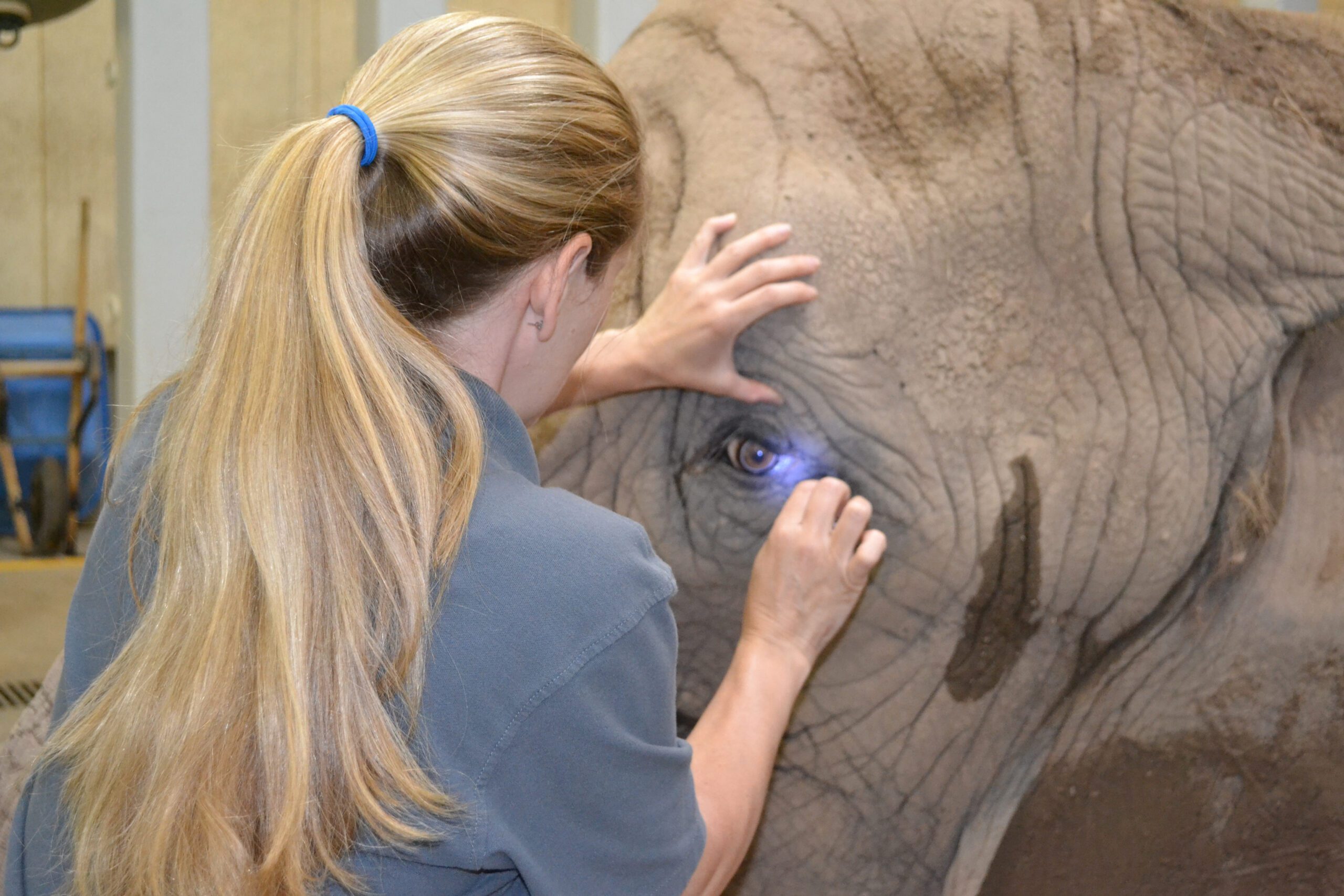
The key to keeping elephants healthy and treating them when they are sick relies on the ability to monitor, test and administer health care and treatment. Proactive training makes monitoring the elephants’ health possible and makes testing and treatment in times of compromised health less stressful for the elephants, for the elephant staff and for the veterinary staff.
The elephant keepers have trained Genny C. and Lilac to accept many veterinary procedures. They are rewarded for willingly participating with their favorite treats, as well as lots of verbal praise. Here are a few examples:
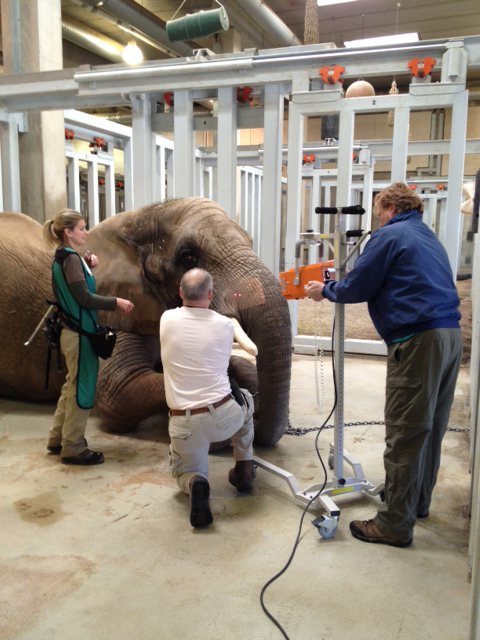
Elephant Manager, Lindsay Bronson works together with the Zoo’s Veterinary Technician Garrett Caulkins and Director of Animal Health & Conservation Dr. Jeff Wyatt to radiograph (take an X-ray) of our African elephant Genny C’s tusk and sulcus.
The sulcus is the area around the tusk. Genny C is happy to participate not only because she is well trained but because she gets lots of treats and positive reinforcement throughout the procedure.
Our elephants know about 60 behaviors, many of which are medical behaviors that allow us to do routine check ups on them. The relationship between the elephants, their keepers and the vet staff is also important when doing medical behaviors. The trust among them all helps to make the procedure go safely and smoothly.
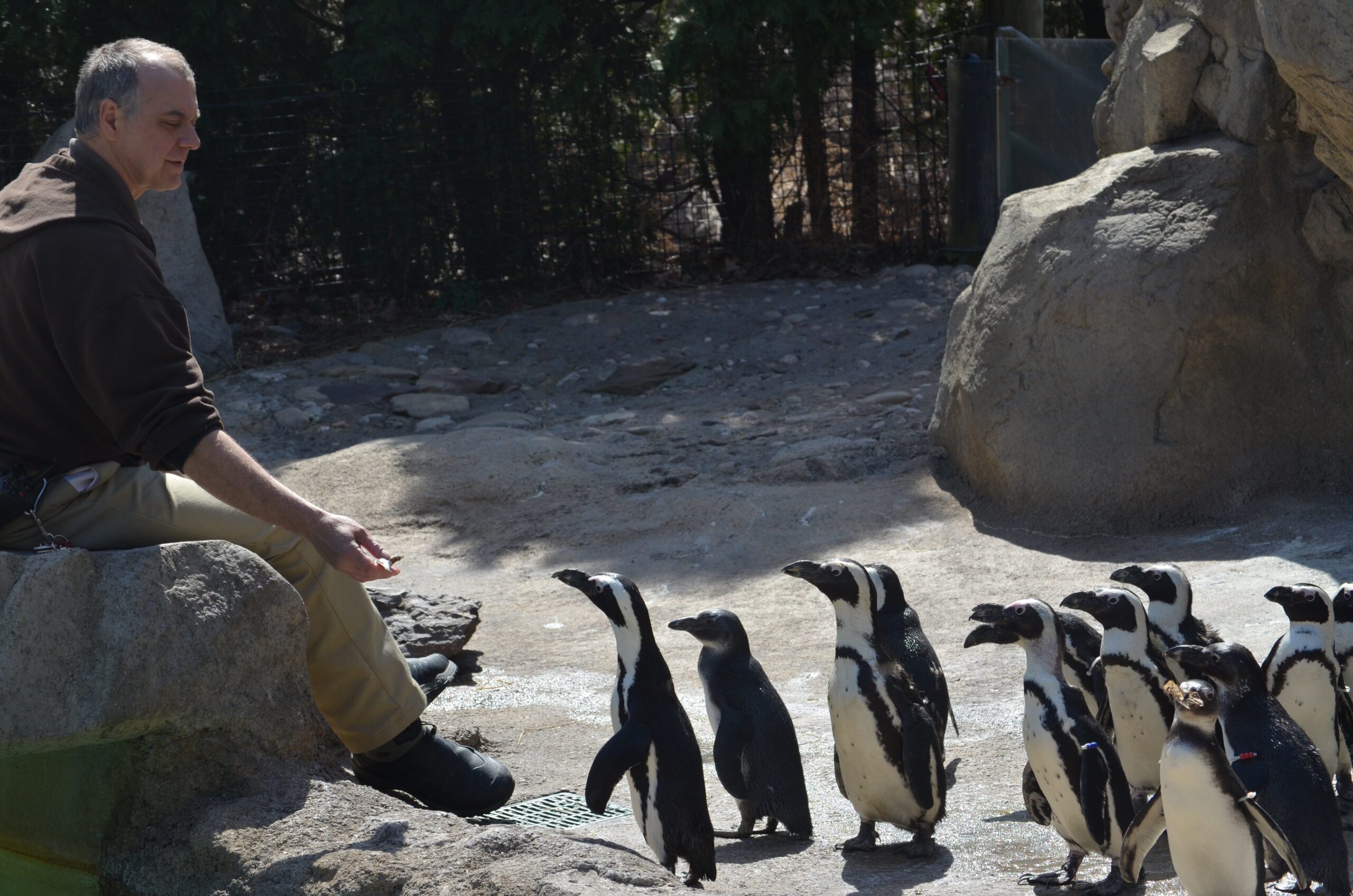
If you spend enough time at the Zoo this summer, you’re likely to get a chance to see our animal care staff feeding our colony of African black-footed penguins. If you stick around until the end of the feeding, you’ll have the opportunity to ask the keeper a few questions about our penguins. Click here to watch a cool time lapse of our penguin feeding.In the meantime, lets take a look at some of the more popular questions asked:
Q: Do they all have names and can you really identify each penguin?
A: Yes, they do all have names and can easily be identified using a number of visual cues, the most obvious being a colored wing band. Each band not only identifies the bird by name but also its sex and genetic family. A band located on the bird’s right wing identifies it as a female while a band on the left wing tells you it is a male. When unbanned, which they are during their molt, keepers can identify penguins by their spot patterns, body size and unique behaviors learned from observing them day after day.
Q: What are you writing on the clipboard?
A: Believe it or not, we make every effort to track what each penguin eats, on a daily basis. As with most animals, a change in feeding habits is the first sign of a health issue. With penguins in particular, an increase in appetite can also be a sign that the bird is about to molt – an annual occurrence where the penguin will drop and replace all its feathers.
Q: How much do the penguins eat? A: Since we’re talking about nearly 40 penguins, that’s a tricky question. Each bird will have slightly different feeding preferences. Some prefer lake smelt, a small freshwater fish while others may prefer capelin, a slightly larger saltwater smelt. These feeding habits also change during the year, especially when approaching a molt. In the days leading up to a molt, a penguin’s daily intake could easily triple as they prepare for time out of the water while they shed their old feather and replace them with new feathers.
While some of our penguins have been recorded eating over 70 fish in one day, statistical analysis of our feed records show that, on average, each bird consumes roughly 16 per day. That equates to roughly one pound of fish per bird per day. Last year, our penguin colony consumed over 230,000 fish, weighing over seven tons and were dispensed over 14,000 vitamins. Not bad for a bird that seldom weighs over 7 pounds!